
Making your own compost is actually a simple and fascinating process. Without going into scientific mumbo jumbo, this article explains the practical basics and where to start. Hopefully you’ll be inspired to make your own compost by the end of reading this.
What is Compost?
mpost is simply decomposed organic matter. But it’s not the same as dirt. If you put a plant in dirt, yes, it will live. Perhaps not for a long time depending on the solid content. And it may not be living it’s best life.
Compost is more like rocket fuel for your plant. It is a natural fertilizer with nutrients and beneficial microbes that replenish the soil. It will cause your plant to thrive not just survive.
Natural forests make their own compost on a daily basis when plant material falls to the ground and animals make droppings. By composting, you are just doing what occurs in nature using a targeted approach. We have controlled and engineered our environment and interrupted this process a great deal living our modern lives. So, you are just helping to resume the process.
Why Should I Make Compost?
Personally, I love making my own compost because:
- It saves me a lot of money
- My plants love it
- It’s a great way to save materials from the landfill
- It’s a satisfying daily ritual
If you don’t have a lot of time, spending $5-$10 on a bag of compost is a good idea. But in the long run, once you start making it, you probably won’t want to stop. No more trips to the store lugging heavy bags! And most of the things you throw in a composter won’t cost you any more money, making it a very cost-effective solution for nourishing your plants.
I’m not against fertilizer, but I’ve found most plants I put in either a container or the ground thrive with added compost. And frequently I don’t need any fertilizer at all.
We eat a lot of vegetables at my house, so collecting veggie scraps for the compost has become part of meal preparation. I look at carrot tops, moldy brocolli and rotten green beans very differently now!
And now when I’m done preparing for meals, I look forward to running outside and dumping my scraps into my bin because I know magic is happening inside and I’m making black gold.
What Do I Need to Make My Compost?
There are a few ways to make your compost. The easiest way is to purchase a rotating barrel-style compost bin. They are already designed to be durable and have built-in ventilation to aid the breakdown process. All you have to do is turn the crank 1-2 rotations each day. For half that cost, there are also free-standing versions, but you provide the labor to “fluff” your compost each day. However, there are also free ways to do it, and you can make your own bin from hardware cloth, chicken wire and I’ve even seen people use storage totes as well. So there’s a solution for every budget. (Check out YouTube for some great videos on the do-it-yourself kind.)
If you can’t put your kitchen scraps directly into your composter every day, I highly recommend keeping a container on your kitchen counter to aid with collection. Personally I find it easier to keep a bowl that I walk outside each day. But there are fancier containers with filters to help minimize your trip outside.
I’ve included some links below of some examples for you.
Amazon.com : Compost Bin Outdoor, 43-Gal Dual Chamber with Steel Frame, Lagre Compost Tumbler with 2 Sliding Door and Aeration System, 360° Rotating, Tumbling Composter Bin for Kitchen, Garden, Yard, Black Yellow : Patio, Lawn & Garden
Amazon.com : Geobin Compost Bin – 246 Gallon, Expandable, Easy Assembly, Made in The USA, Outdoor & Backyard Composter : Home & Kitchen
Amazon.com: EPICA Countertop Compost Bin Kitchen | 1.3 Gallon | Odorless Composting Bin with Carbon Filters | Indoor Compost Bin with Lid | Stainless Steel Kitchen Composter for Food Scraps & Waste Recycling: Indoor Compost Bins: Home & Kitchen
What Can You Put in Your Compost?
Compost is comprised of organic plant matter, not animal matter, so you cannot throw rotten hamburgers, chicken bones, dairy, oils or dead skunks in your composter. (Just kidding!) However, veggie and fruit scraps are great, and so is fruit. So think GREEN.
Then you want to throw in dead leaves, pinecones, hay, and tiny twigs. So think BROWN.
You want the mix to be about 50/50 GREEN & BROWN. (If it isn’t, read what happens below.)
And then there’s some fun things you can throw in your composter that you probably wouldn’t expect like:
- Rotten vegetables and fruit you forgot about in the back of the refrigerator (GREEN) – I know you meant to eat it, but hey, life happens! Moldy & stinky is OK. Congratulations – it’s not completely wasted now.
- Cardboard (BROWN) – just make sure it’s plant-based ink with no labels, stickers or tape and it’s plain brown
- Lint from the dryer (BROWN) – Yes! That stuff you have to get rid of after every load of laundry can go in your composter. (Just be sure that you didn’t use fabric softener with it because it won’t break down and could be toxic.)
- Coffee grounds (GREEN)- They provide nitrogen and other trace elements. Score!
- Newspaper (BROWN)- Once you’re informed and read the comics, into the composter they go.
- Crushed Egg Shells (BROWN)- They provide calcium to your plants ( And bonus: it releases slowly feeding your plants over time.)
- Ash from your fireplace – This provides calcium and other trace elements.
Pro Tip:
Keep your brown materials near your composter (like dead leaves). If you throw in some raw vegetable scraps, throw an equal amount of leaves in right afterward. This keeps the mix even every day so it never gets out of balance.
I Got Everything Set Up - Now What?
Now… we wait!
Once you’ve acquired your equipment, then all you need is to start your daily routine. If you have a barrel composter, then you turn the crank 1-2 revolutions per day. If you miss a day sometimes, it will be fine. But without the continual supply of oxygen, the process could change and everything could stop decomposing and start rotting instead. (There is science behind this that I won’t cover in this article.) The big clue is that it will start smelling BAD. We’re talking dive for the clothespin or chip clip for your nose BAD. Otherwise, it will just have an “earthy” smell, like strong freshly-mowed grass.
And seeing occasional bugs is normal as well. Actually, they can aid in the decomposition process so don’t panic if you see a roach scurry out of your compost. Ewwwe!
TIP: If you see worms or larve in your compost, this is not the end of the world either. However, some people, including myself think this is GROSS. If you want them gone, just sprinkle some garden lime in your compost and they will pack their bags and move out of your compost hotel.
How Long Before I Can Use My Compost?
It can take from 1-3 months to create a batch of compost. This highly depends on how much you are feeding into each day. I usually fill my composter for about 2 months and then stop to allow it to more fully break down. Otherwise, you can just keep going for weeks until it gets really hard to turn the crank.
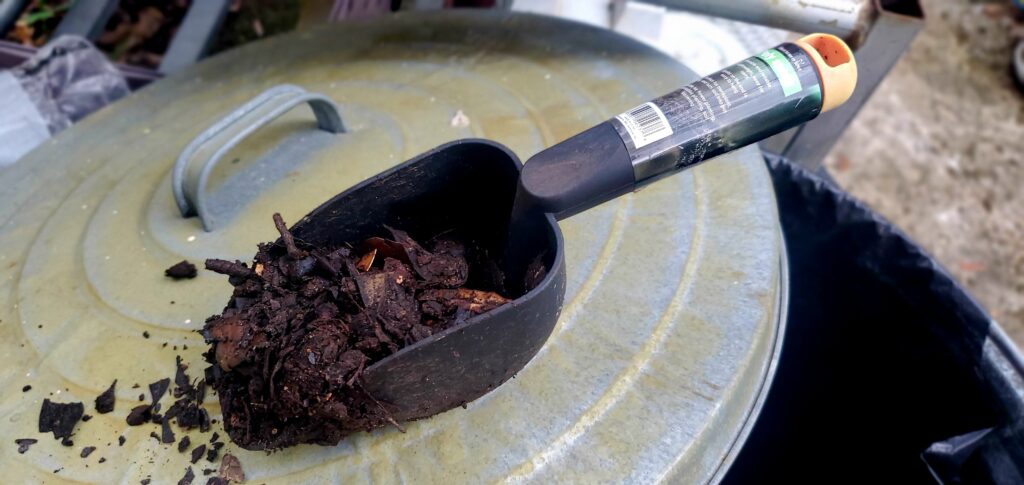
Once the batch is done, it will look a lot like dirt with some “chunks” in it. The chunks are OK because once you add them to a pot or soil, it will just continue to decompose and feed your plants.




 More Lovely Categories to Explore